Large signs leading into Hammonton inform visitors they are about to enter “The Blueberry Capital of the World.” What the signs don’t say is that visitors are also entering the unofficial Italian-American capital of Jersey.
According to the 2010 census and the latest American Community Survey figures, 44.6 percent of Hammonton’s 14,791 residents are of Italian ancestry, the highest percentage in New Jersey. (Toms River has the most residents of Italian ancestry, 29,313, but that is just 33 percent of the town’s population.)
“Italian heritage is a huge part of our identity here,” says Kristin Keating (nee Colasurdo), president of the Hammonton Historical Society. “We’ve kept a lot of traditions alive from generation to generation, and we take great pride in our past.”
The roots of Hammonton’s Italian heritage can be found literally in the ground. Officially incorporated in 1866, Hammonton was the product of an agrarian vision shared by two Philadelphia land-development partners, Charles Landis (founder of nearby Vineland) and Richard Byrnes. “[The soil] was mostly sand, but it had a very high organic content,” says Harry Stafford, trustee of the historical society and Hammonton resident of 40 years. “They called it green sand. With enough water, you could grow almost anything.” By the late 1800s, Hammonton was one of the country’s largest exporters of all kinds of berries.
By almost every account, the unprecedented Italian influx can be attributed to one man, an Italian farmer named Salvador Calabrese who came to Hammonton in 1863 from tiny Gesso, Sicily. Calabrese wrote to two of his countrymen in Gesso, petitioning them to come start farms of their own. Within a few years most of the town of Gesso had relocated to Hammonton. Additionally, an organization called the Italian Labor Bureau was contracted at the time to supply Italian day laborers from nearby Philadelphia to harvest crops and work the fields. Slowly but surely, says Stafford, these laborers began buying land of their own and encouraging family members in Italy to join them.
By 1920, Stafford says, Italian surnames comprised more than 60 percent of the population. This new generation played a major role in Hammonton’s growing textile industry. By 1930, Hammonton was home to about a dozen different garment factories.
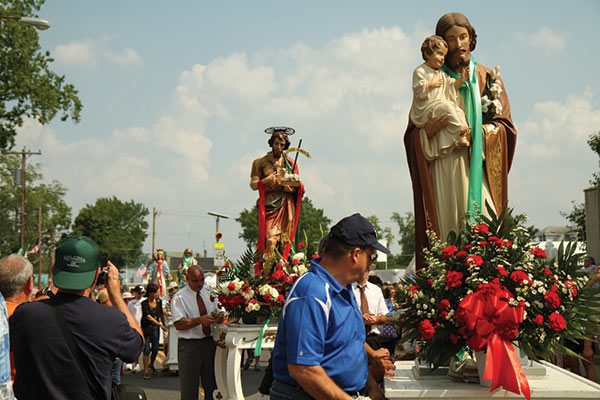
Today, for all its ethnicity, Hammonton has just an average number of Italian restaurants, delis and pizzerias. But the standout event on the calendar is the annual Italian Festival sponsored by the Our Lady of Mount Carmel Society. What began in 1875 as a traditional Roman Catholic two-mile long procession of saints has evolved into the longest running Italian festival in the country, with a weeklong carnival and festivities erupting every July.
Agriculturally, winemaking has emerged in recent decades as one of Hammonton’s most vibrant industries. The town is home to three celebrated South Jersey vineyards: Plagido’s Winery, DiMatteo Vineyards and Tomasello Winery, which was started by one of the town’s oldest Italian families and has been making wine for almost 80 years.
“We are the next generation of leaders, and we have a sense of pride in our heritage,” says Keating. “We’re all Americans, but we will also continue to preserve our past.”
Colasurdo is the last name of my choir director in Campobasso. We’re going to perform along the city streets on Good Friday – there will be 800 voices following the procession of the dead Christ and Our Lady of Sorrow through the oldest part of the city. This is one of the most evocative and oldest traditions in the south of Italy, a land full of beautiful feasts and celebrations linked to the people’s faith and devotion towards God, the Saints and the wonderful land He gave us together with the marvellous gift of life.
We are so blessed, and so grateful to inhabit such a beautiful territory. And I am so happy that nowadays we can share such celebrations worldwide because of the internet.
Scot and I work as travel agents in Tuscany, and as tour guides all over Italy; very often, and very proudly, we show Americans the wonders of our South, especially Sicily, which I love most. If you wish to visit Sicily, visit our website http://www.lovingItaly.us . We have many great itineraries all over the country. Happy Easter!!