

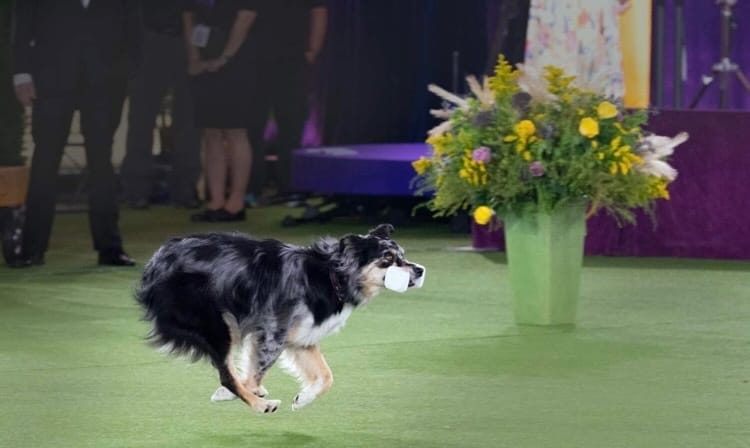
Owners, handlers, groomers and their prized pups are converging on the Jacob Javits Center on Monday, February 2, with blow dryers, brushes and treats.
That’s right, the Westminster Kennel Club dog show is back in New York this week. And this year, the traditional breed show turns 150.
Contenders of the canine and human variety already raced through the ring in timed agility finals Saturday. But as the show’s sesquicentennial event takes the city, one event is noticeably absent: the Westminster Masters Obedience Championship.
Westminster is the second-longest running continuously held sporting event in the United States. The dog show started in 1877 at Gilmore’s Garden, which would become Madison Square Garden, two years after the Kentucky Derby debuted in 1875. Obedience competition was added in 2016.
For a decade, dogs in the obedience ring demonstrated mastery of commands from their owners and trainers. The scene was quieter and less frenzied than agility, but required no less focus. A sparkling performance relies on a similarly watertight connection between dog and owner. Dogs are expected to be completely attuned to their owners, not distracted by other people and dogs. For much of the competition, they remain close at their owners’ side, walking in lockstep with their human, until they receive a command to stay in place, jump over a bar or retrieve an object.

Warren County’s Linda Brennan and her Labrador retriever Heart after their win at the Westminster Masters Obedience Championship in 2019. Photo: JC Photography
And when it came to obedience, New Jersey dogs absolutely dominated.
Dog-owner teams from the Garden State won the obedience championship in eight out of 10 years.
So what happened? Why did Westminster Kennel Club axe the competition?
Word that obedience was no longer part of the high-profile show arrived via omission, to the dismay of trainers and competitors who call the obedience stronghold home. Linda Brennan and her Labrador retriever Heart won the Westminster Masters Obedience Championship so many times, they retired the trophy in 2020. But when a press release announcing the Westminster judges for 2026 was published last year without any mention of obedience judging, her friends in the obedience community started talking.
“A couple people texted me right away and said ‘Hey, it doesn’t say anything about obedience,’ ” Brennan tells New Jersey Monthly. “And I said ‘Well, as far as I know, they’re having obedience.’”
Brennan texted Paul Campanella, senior director of event operations at Westminster Kennel Club, who confirmed what the others suspected.
“I just said ‘I’m really disappointed,’ ” says Brennan, who lives in Columbia, Warren County. She followed up with an email about her concerns.
Brennan works as an instructor at Top Dog Obedience School in Flanders and has long been a booster of obedience at Westminster, both behind the scenes and in the ring. She won with Heart, her super attentive black Lab, at the show’s first obedience championship in 2016, then proceeded to win again in 2017, 2018, 2019 and 2020.

Brennan and Heart at a party celebrating their fifth Westminster Masters Obedience Championship win in 2020. (Check the five ribbons!) Photo courtesy of Linda Brennan
Representatives for the Westminster Kennel Club dog show declined to offer comment when New Jersey Monthly asked about the discontinuation of the obedience competition.
But Brennan says that Campanella laid out a few reasons for the decision in his response to her email. One was a perceived lack of spectator appeal.
Obedience didn’t draw the kind of audience associated with the traditional breed show or agility, but much of that is by design. Agility, an adrenaline burst of a sport, sees dogs navigate a timed obstacle course, with owners running alongside the furry blurs to guide them. The final is broadcast live on Fox (it aired January 31), while group breed competition and best in show is televised on cable (FS1 Monday and Tuesday night). While obedience could be streamed online and clips were part of cable coverage, the event never received major TV attention.
Even for those attending in person, the obedience ring could be unintentionally missed. Depending on the year and schedule, there’d be simultaneous competition in many different breeds or agility preliminaries.
One issue that popped up over the years was the reaction to the freestyle part of obedience at Westminster. Dogs and owners would deliver fanciful routines using themed props. In 2019, Brennan took inspiration from the 1956 French film The Red Balloon. Heart stole hearts when she fetched a big red balloon in the ring. Other competitors embraced The X-Files (FBI jackets, retrievable UFO) and Harry Potter (wand, wizard hat). The freestyle routines added a bit of playfulness to obedience and could draw more spectators, but not everyone was a fan.
Some competitors didn’t see the point in having to come up with a more creative presentation, or didn’t want to train their dogs to do something they’d only have to do at one competition. Others worried about a larger crowd distracting their dogs. After freestyle was eliminated in 2020, Westminster didn’t have a problem filling obedience entries, Brennan says.
“A few of us loved it,” she says, adding that she was lucky because Heart wasn’t easily distracted.
Another reason Westminster gave for deciding not to continue with obedience was a lack of space and money, Brennan says. Trophies and ribbons will not be awarded for obedience at the 2026 dog show, but the longtime obedience trainer is hosting a series of obedience demonstrations at the invitation of the kennel club. She’s had a similar presence at the last three shows.

Brennan and Heart at the Westminster Kennel Club dog show in 2018. They had a five-year winning streak, triumphing in the Westminster Masters Obedience Championship in 2016, 2017, 2018, 2019 and 2020 before retiring the trophy. Photo: Amy Kuperinsky
“I said, quite frankly, ‘Why would I do this?’ ” Brennan says. “‘I did it because you supported the sport of obedience, and now you’re not.’ ”
But she agreed to provide the expanded demonstrations and several talks, which started January 31 and end February 3, the last day of the show at the Javits Center, before the best in show competition takes place at Madison Square Garden that night.
“They’re paying me to do it because I’m not doing it for free,” she says. “I mean, it’s still a big loss for me, because I’m putting way more time into it than I’m getting compensated for, plus I have nine other people volunteering who are in it who are going to get a small stipend.”
Rallying for a Return
Brennan says some influential figures at Westminster who supported obedience have since died or parted ways with the kennel club. But by continuing to represent obedience at the dog show, she plans to urge the kennel club to restore the competition.
“I’m going to make a pitch to get obedience back, which I probably don’t think has a huge chance of success, but I’m going to do it,” she says. “I’m going to get popular support behind me … I’m going to present it in a way that I hope will make it more palatable and address their concerns. And I don’t know what’s going to happen, but our sport can ill afford to lose a prestigious showcase.”
After Heart’s fifth Westminster obedience win retired the trophy in 2020, Brennan had an early March party to celebrate at Top Dog, the obedience school. It was a week before the Covid-19 shutdowns.
“We were so lucky to get it in,” she says. In October of that year, the champion dog was diagnosed with histiocytic sarcoma. Heart died on Valentine’s Day in 2021. To honor her “very special dog,” Brennan hosted a virtual fundraiser for charity in support of the Animal Medical Center in New York, where the Lab had received treatment.
New Jersey: The Obedience State
In addition to training, Brennan is still competing in obedience. She currently has two black Labs and a Welsh springer spaniel. Another winning Westminster obedience team from New Jersey is joining her at the dog show for obedience demonstrations.
Kathleen Keller of Flemington and her Australian shepherd Willie won the Westminster Masters Obedience Championship in 2022, then pulled a repeat win in 2025. “The state of New Jersey produces a lot of obedience trial champions,” she says. Keller has competed nationally with her dog and either competed or helped out at Westminster every year that obedience was part of the show.
For a sport that can often lack recognition in the wider dog show world, the loss of the showcase was a deflating setback.
“I was sad because we always considered that one of our top events for the year,” says Keller, one of many obedience contenders who trek from state to state. Keller and Willie have competed at the invitation-only American Kennel Club National Obedience Championship, which is in Wilmington, Ohio this July, and the AKC Obedience Classic, which happens each December in Orlando. “It’s not an easy sport and you don’t get ribbons right away,” Keller says. “It takes a lot of time and at least a couple of years before you’re even really ready to step into an obedience ring with your dog, but it’s well worth it.”
Obedience is a sport that prizes precision. Keller was drawn in by one required skill—scent discrimination. In a group of objects, dogs must be able to pick out the one that carries their owner’s scent.
“I’m like ‘That is so cool. I want my dog to be able to do that,’ ” she says.
Keller and Willie, 8, train at Top Dog with Brennan. She devotes one hour each day to Willie and one hour to working with Marina, her 6-year-old Shetland sheepdog.
“Obedience is a demonstration of that bond between the owner and the dog,” Keller says. “For me, there’s nothing like it … When I was in the ring with Willie, we can block out everything else that’s going on around us and just focus on each other. It’s an amazing connection.”
Obedience training starts as young as 8 weeks old. Brennan and Keller’s Westminster demonstration covers topics like puppy training, competition and how obedience is used in other dog sports. “Our ultimate goal is that they bring back our obedience competition,” Keller says. Being a somewhat staid display of focus, calm and control, obedience isn’t as flashy as agility with all of its lightning-fast border collies, but it’s still a part of what is happening in that ring, too. “You have to have obedience to do all of the dog sports,” she says. “It’s the core, it’s the foundation for all other sports.”
The Beginning, Middle and End
Mary Ann Flanagan won the Westminster Masters Obedience Championship with her Labrador retriever Grant in 2021. “I would love to see it returned,” she says.
Flanagan, who lives in Glen Gardner, initially wanted to try agility. She made an attempt with a dog that did not have obedience training. “It was a disaster fast,” she says. But when she did venture into obedience with another dog, she was hooked.
“I just think obedience is the beginning, the middle and the end of any other sport that we do,” says Flanagan, who also trains with Brennan. Grant, her obedience champion, died in 2023. Now she works with her 3-year-old Lab, Bond (“as in James Bond,” she says), a cousin to Grant, in obedience and agility, which was added to Westminster in 2014.
While purebred dogs dominated obedience at Westminster, since the sport wasn’t based on breed conformation, it was one of the few parts of the dog show open to mixed-breed dogs, which the kennel club calls “All American” dogs (agility has an award for top All-American dog). Though obedience competition wasn’t added to the dog show until 2016, Keller points out that obedience has been a part of the 150-year-old event in decades past — Westminster has videos on its YouTube channel of group obedience demonstrations from the dog show in 1949.
As obedience has again been relegated to demonstration status, Brennan points out that a boisterous flyball tournament was added to Westminster last year. In the relay-like team sport, dogs jump over hurdles and race to release a ball. As with agility, speed is a major factor, and the action moves fast. In contrast to obedience, there’s also a fair amount of barking in the ring.
Brennan has some suggestions for how to make obedience more compelling to passersby and Westminster visitors who aren’t versed in the sport.
“One of the things I’m certainly going to propose in trying to bring it back is, put it out where people can see it,” she says. “People will just have to understand if they enter it, to compete, this is the conditions you’re competing under. It’s going to be challenging, but it’s going to be good. And have somebody commentate — which I would be more than willing to do — so that the public knows what they’re looking at, and try to make it interesting for people. Because on the one hand, they sort of acknowledge that obedience is important and they want to show that to the public, but they don’t want to support our actual sport by offering competition.”
Keller and Brennan compare obedience to dressage in the world of horse training: A sport of precision that may not mean much to those who don’t know what’s happening. Flanagan draws a parallel to the way some people think golf is slow and uninteresting — like “watching paint dry,” she says.
“Once you understand the sport and understand the skill behind the sport, you have more appreciation for it.”



-
Helen J Shen Wants You to See ‘The Devil Wears Prada 2’ at Bernardsville Cinema
-
Recapping the Bruce Springsteen Center’s Intimate, Raucous 2026 American Music Honors
-
‘Widow’s Bay’ Was Inspired By a Haunted Jersey Shore House
-
Grease Lightning: South Jersey Band Powers Tour Bus With Recycled Cooking Oil


