

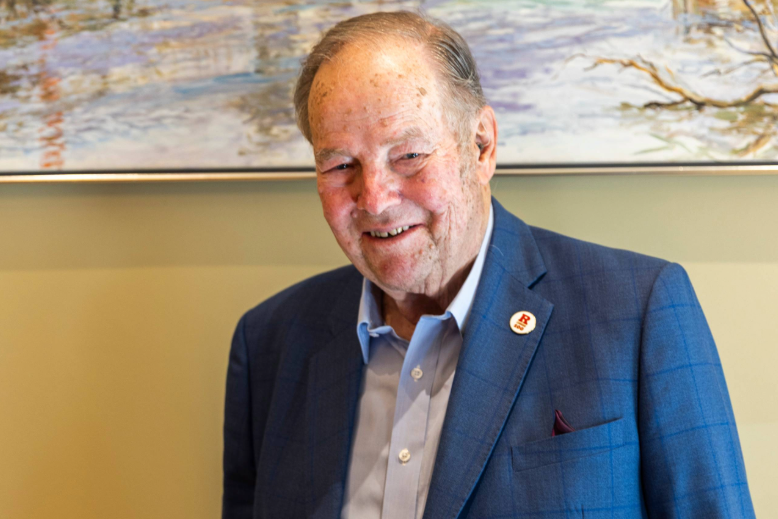
Happy birthday on April 21 to former New Jersey Governor Thomas H. Kean, who remains vibrant and astute as he turns 91.
On April 16, Kean, who served two back-to-back terms as governor of the Garden State from 1982-90, engaged in a Q&A at Rutgers University’s Camden campus as the fifth annual guest speaker in the campus’s Chancellor Lecture Series. Chancellor Antonio D. Tillis, Ph.D., who founded the series in 2022, invited Kean to campus to discuss the former governor’s accomplishments both in and out of office, his thoughts on what makes a successful elected official and some ideas included in his 1988 book, The Politics of Inclusion.
“Bipartisan” is the word Kean emphasized over and over during his hour-long public conversation with Tillis. One of Tillis’s questions acknowledged the former governor’s “bipartisan and pragmatic approach to public service,” to which Kean replied, “It’s the way I’ve always approached everything else: common sense.”
Kean, a Republican, mused, “We live in a different time now in two very important ways. Back then, we had a real bipartisanship. We got along with each other. We argued all day and then we’d have dinner together at night. Republicans and Democrats attended each other’s weddings and funerals. We wanted nothing but the best for each other.”
The other important difference between then and now, Kean said, is “the ability to compromise. We had to compromise for every major accomplishment that was made.”
He added, “Unless you’re willing to do both, you’ll have trouble getting anything done.”
Kean, who coined the motto “New Jersey and You: Perfect Together,” was instrumental in creating NJPAC, Liberty Science Center and the now-Adventure Aquarium in Camden, all part of his plan to revitalize New Jersey’s urban centers and fulfill his “politics of inclusion” strategy.
“There are over a hundred ethnic groups in the state of New Jersey,” he pointed out. “Inclusion means everybody, all races. I have a particular relationship with African Americans. There are very few African American judges. If your aim is justice, you’ve got to be inclusive. Law schools are not accepting enough African Americans. We must make sure they have some say in government regarding the people who look like them.”
Tillis observed to Kean, “Education reform was your signature during your time in office. What lessons endure?”
Kean’s reply: “I believe that nothing is more important than education. I remember the name of every teacher I had 85 years ago. I wouldn’t have become governor without my teachers’ influence.”
To correct failures in any educational system, Kean explained, “First, you must identify the problems. Once they’re identified, don’t take small steps to solve them. Governors don’t have enough time to take small steps to accomplish anything.”
The first big step Kean made in improving the Garden State’s educational system was to raise teachers’ salaries, which, he noted, were so low that the state “had a looming teacher shortage.” His response was to “raise teachers’ salaries by about 30 or 40 percent. There was some opposition, but we got the bill through statewide.”
As a result, he recalled, “we had a flood of new teachers.”
He also noted, “Why should the majority of the budget go to school administrators? It should go to teachers. Another thing is that teachers don’t get paid one cent more the better the job they do. That doesn’t make any sense to me.”

Former Governor Kean with Rutgers-Camden Chancellor Antonio D. Tillis. Photo: Ronald Downes, Jr./ Rutgers University-Camden
Following the 9/11 tragedy, President George W. Bush appointed Kean chair of the National Commission on Terrorist Attacks Upon the United States, commonly known as the 9/11 Commission.
“It felt like somebody threw a load of bricks on me,” he remembers of the assignment. “But you couldn’t say no. Congress wanted to to it themselves but they did a terrible job.”
He remembered, “When I went into the room where our first meeting was to be held, I found Democrats sitting on one side, Republicans on the other. I changed that, saying that never again do I want to see a Republican sitting next to a Republican, a Democrat sitting next to a Democrat. Republicans and Democrats working together. That’s what I want to see.”
Kean was impressed most of all by the families of those killed or injured by 9/11 events. “They’re the most extraordinary people I ever met,” he said. “Instead of going into mourning, they went into action. They went to Washington, asking how did this happen? They picketed the White House every day, sat on the steps of Congress members, forced Congress to pass a recommendation and forced the president to sign it.”
Kean worked closely on the commission with Lee H. Hamilton, who died last February 3. Kean and Hamilton, an attorney and member of the U.S. House of Representatives and the Homeland Security Advising Council, co-authored a book about the commission titled Without Precedent: The Inside Story of the 9/11 Commission.
The book, published in 2007, focuses on how the commission overcame partisanship and bureaucracy to produce its acclaimed report.
“I’m very proud of that report,” Kean told his Rutgers-Camden audience. “It’s still used in college classrooms.”
Hamilton was a Democrat, Kean a Republican, yet they seamlessly worked together, the former governor stressed. “Lee Hamilton,” he said, “was one of the most decent people you’ve ever met. I consulted him every chance I got. We ran the commission together with the help of the families of 9-11 victims.”
When asked what advice he would give to someone planning to enter government service, Kean repeated Winston Churchill’s words: “Study history, study history.”
He said, “I can’t give better advice.”
The April 16 event, held in the Campus Center meeting room, attracted not only Rutgers-Camden students and alumni, faculty members, and administrators, but also area activists and elected officials. Among them were retired Assemblywoman Patricia Egan Jones, who spearheaded the drive to keep the USS Battleship New Jersey on the Camden waterfront; Colonel Nelson L. Mellitz, past New Jersey state commander of Jewish War Veterans; Colonel Ted Gallagher, executive director of the Camden County Office of Veterans Affairs; Camden City Councilwoman and Rutgers-Camden graduate Jannette Ramos; Michael Egenton, executive vice-chair of the New Jersey Chamber of Commerce; Margaret Marsh, history professor and former interim Rutgers-Camden chancellor; and James H. Rhodes, Rutgers-Camden’s alumnus of the year, who will be inducted on April 23 into the Rutgers University Hall of Distinguished Alumni.


