

The smell of a young tomato vine is like perfume to me. The sweet fragrance of white nicotiana can cool me down on a humid August night. When I stir leaves of cherry, sassafras and maple into my compost bin in the fall, the woodsy aroma is a toast to the end of the growing season.
I became attuned to all these scents when I took up gardening. I became more aware of what the smells signified when I officially became a Rutgers Master Gardener in 2022. And so it has been, in every spring since, that the smell of soil and seedlings in a greenhouse tells me I’ve been given a clean slate, a fresh start, much the way the smell of back-to-school notebooks and sharpened pencils energized me as a child. It’s time to learn and it’s time to grow.
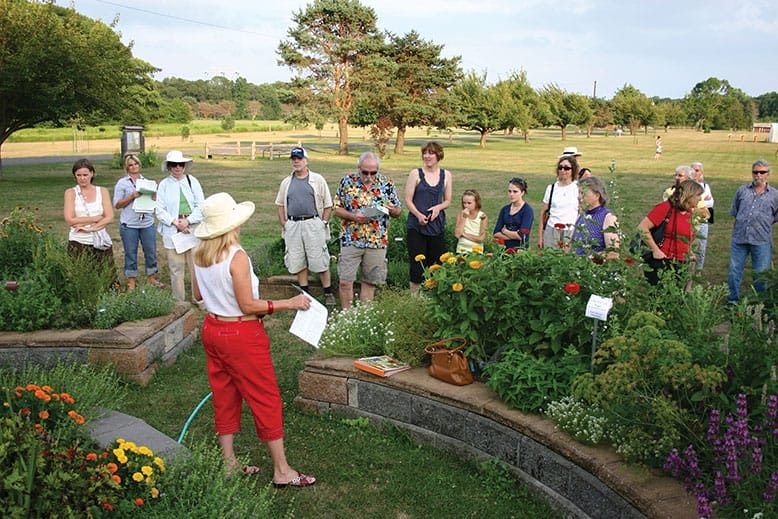
You’ve probably come across us Master Gardeners before. We’re the people who give presentations on pollinators at your local library or senior center. We staff the tables at festivals and county fairs with displays about invasive plants or container gardening. We give out fact sheets, pamphlets and little laminated cards that you can use to scrape the eggs of spotted lanternflies off your trees. We also run help lines. Call us to ask whether we think your spaghetti squash is suffering from a bacterial, viral or fungal infection, or if some pernicious bug is boring through your vines. We’ll give you advice, and if we don’t know the answer on the spot, we’ll do some research and get back to you. We are enthusiastic, expert volunteers.
We don’t start out that way when we enroll in the Master Gardener program, which combines lectures, presentations, labs and fieldwork. “The majority have a surface-level understanding or interest in gardening and want to learn more,” says Angela Monaghan, Master Gardener program coordinator for Rutgers Cooperative Extension of Middlesex County, part of the Rutgers New Jersey Agricultural Experiment Station.

Junior butterfly enthusiasts try their nets at the Earth Center in South Brunswick. Photo: Courtesy of Rutgers Cooperative Extension
Under Monaghan’s tutelage, my Master Gardener training began in September 2021 with weekly classes at the Earth Center at Davidson’s Mill Pond Park in South Brunswick, headquarters for Rutgers Master Gardeners of Middlesex County. Our classes ran through spring of 2022, after which we interns logged at least 60 hours of fieldwork through the summer before graduating in October. The timing of the Master Gardener program has shifted since then, but the basic format remains the same.
There are a midterm and a final exam, which cover material learned throughout the year: botany, entomology, pest and disease diagnostics, water quality and conservation, soil science, wetlands and wildlife, herbs and houseplants, herbaceous and woody plants, elements of landscape design, turf grass and its alternatives, aquatic gardening, invasive and native species, annuals and perennials, vegetables, weeds, fertilizers, composting, parts of a flower, pesticides and integrated pest management, fruit trees, pruning and propagation, photosynthesis and more. Those are just a few of the topics I labeled with Post-it notes in my overstuffed three-ring binder.
I studied hard for a full week before the midterm, my dining room table strewn with notebooks, highlighters, pencils and scrap paper. The exams are open book, so I assumed I was overdoing it. I was the first one in class to finish the exam, and I got close to a perfect score. But, had I slacked off studying, I would have been sunk. You can’t waste time in a three-hour test period digging through pages of source material.

Photo: Courtesy of Rutgers Cooperative Extension
It was a good lesson in and of itself. The Master Gardener program is not a degree-granting endeavor. But college professors and other experts do give the lectures and presentations. It is a scholarly pursuit. By graduation, you will have mastered the elements of home gardening in academic theory and in applied practice. Then, you pay it forward, renewing your certification annually with volunteer hours and continuing education, helping members of the public find answers to their questions and teaching them how to find answers on their own. There is a fee to enroll in the program, but there’s no cost to renew your certification.
“We receive support from the county in recognition of the importance of what we do,” Monaghan says. “Rutgers Cooperative Extension is the outreach branch of the university—agricultural outreach, primarily—so there is an Extension office in every county. It is a partnership between Rutgers University and the counties.”
The approximately 150 active, certified Master Gardeners in Middlesex County further extend that outreach to home gardeners, students and the public, Monaghan explains. “Our three most important forms of outreach are our gardens, our help line and our speakers’ bureau.”
Rutgers Master Gardeners are lucky to be able to provide outreach on the 499 acres of park space and woodlands at Davidson’s Mill Pond Park. The Earth Center at the park includes: an elaborate children’s garden; a native plants trail and nursery; a fruit garden; several vegetable and flower gardens; the Circle of Thyme herb garden; Rows for the Hungry, a veritable farm that produces fresh vegetables for people in need; and a spectacular butterfly house that is open to the public on summer weekends, with free admission. All these gardens are maintained by Master Gardener volunteers.
Through the winter, we brush up on our skills, attend workshops and webinars, and page through seed catalogues with the longing familiar to any backyard gardener. By the end of February, volunteer shifts begin in greenhouses on the Rutgers Cook campus in New Brunswick. It is my favorite task and my favorite time of the growing season.
When I open the door to the greenhouse on a muddy, gray, late-winter’s day, some of the heat seeps out and envelops me. I am greeted by the fresh, invigorating scent of soil and seedlings, and by the salutations of my fellow gardeners, who are bent over seed trays, sowing, watering and labeling. By the time you read this, our seedlings will be ready for our plant sales and display gardens. But right now, as I write this, we are at the very beginning of the process, when there is promise in every seed, potential in every set of true leaves, and serenity in knowing that nature will take its course.
For information on the Master Gardener program, or to find the phone number for your local help line, go to njaes.rutgers.edu and click the link for your county.
Kelly-Jane Cotter is a frequent contributor to New Jersey Monthly.


