

No more fumbling with your wallet or change purse at Atlantic City Expressway toll booths.
That’s because South Jersey’s “seashore highway” between Turnersville (Gloucester County) and Atlantic City has gone cashless, marking New Jersey’s first major roadway to do so.
It’s the end of an era when humans in little huts extended their palms to collect paper bills and coins from motorists on the 44.2-mile toll road.
Starting in 1965, when the expressway was completed, cash transactions were the sole method of toll taking on that roadway until 2012, when E-ZPass arrived.
Since then, more than 80 percent of drivers using the expressway have signed up for E-ZPass, letting the transponder on their dashboard pay tolls electronically, according to Karen Hutchings, director of tolls for the South Jersey Transportation Authority (SJTA). Meanwhile the non-E-ZPass drivers continued paying in cash.
But at 8 pm on January 4, A.C. Expressway toll collectors were laid off en masse, replaced by electronic gantries with scanners and cameras collecting license-plate information. Drivers without E-ZPass now receive invoices in the mail charging more than double the E-ZPass fees: $6.49 from start to finish of the expressway for E-ZPass drivers and $13.98 for everyone else.
“Yes, we’re encouraging drivers who don’t already use E-ZPass to sign up for it,” acknowledges Hutchings. “But it does cost a lot of money to run the toll-by-mail system—having to look up license plate information, processing and mailing invoices.”
So why no more toll collectors? “Safety is one of the big reasons we did this,” Hutchings explains. “In just the two years I’ve been here, we’ve had many accidents at toll booths, with drivers either crashing into the booth or the concrete ballard next to it. There have been several fatal accidents at the Egg Harbor toll plaza.”
Another reason for the new cashless system, she points out, is “the convenience of not having to stop to pay.” Drivers, she says, are also sure to appreciate the third lane that’s being added in each direction.
A.C. Expressway toll collector Allison E. Allen, who was on duty for the last shift on January 4, describes the final moment: “At 8 our computers shut off, our screens went black. We were cleaning everything out, things like the bill scanner that tells whether twenties or fifties are counterfeit.”
The 41-year-old Pleasantville resident, who was on the job since August of 2025, says, “I was a chapter in history, privileged to work in a job that no longer exists.” The toll collectors received severance pay from the contractor that hired them and were invited to attend a job fair in their search for new employment.
“I loved lots of things about the job,” muses Allen, a licensed massage therapist. “My favorite thing was working as a team. I also liked how sensory it was: the sound of the cars, the fresh air, being semi-outdoors, the tactile change and visual stimulus from the computer and chronicling a written report. Even the smell of the marsh was grounding at times.”

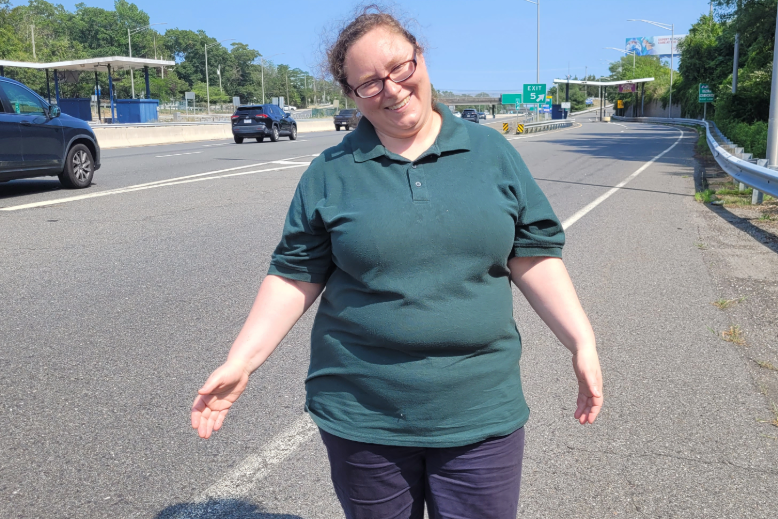
Allen poses in July. Photo: Barbara Leap
Allen was anything but aloof as she collected tolls, noting that she “really enjoyed telling people that they were wearing a color that looked particularly good on them. Seeing people from my community was neat, too.”
On Christmas Day, with permission from her supervisor, she offered 300 drivers little slips of paper she’d printed at home containing a few lines from a hymn, “Was It For Me?” “I explained to each driver that it was a gift from me, not the transportation authority,” says Allen, a devout Christian. “I had one person refuse, but that’s OK. Another person prayed right there with me.” Most of the drivers that day, she thinks, were casino employees heading to work.
“Being a toll booth collector was a childhood dream job for me, starting around age six,” Allen says. When it came to a halt, she received a text from a friend that said “I’m glad you got to do your dream job, but sorry it had to be turned over to a robot.”
Among the many drivers who stand out in her memory:
- “The man who drove with his feet. His skill was so fluid, it took a minute for me to process he had no arms. He would hand me a small bag to take money out of or a sufficient bill to make change from. He could grip the bill portion of the change between his toes, but I had to ask how to give him the coins. He guided me to place them on top of his foot so he could throw them on the floor and clean up later.”
- “The woman who was honest when I casually said, ‘Hello. How are you?’ In a very firm, real, piercing tone came her reply, ‘I don’t want to go home.’ I suspected abuse and pray for her still.”
- “My first flirt,” she says, “was the worst because it was new, but also the most intense. My comment, ‘I can make change,’ was met with ‘I can make babies.’ I ignored him.”
Hutchings was on the scene at the Egg Harbor Toll Plaza when cash transactions ceased. “I walked out with two of the collectors,” she says.“They weren’t crying, but they almost looked lost.”

A New Jersey toll collector from the 1980s, well before E-ZPass was established. Photo: Shutterstock/Joseph Sohm
SJTA Toll Operations Manager Barry J. Goldstein was there, too. “The shutdown of the cash booths was seamless,” he notes, adding that he made the arrangements. “But the atmosphere was kind of eerie. The toll collectors were sad. Their management company held a party for them at each toll plaza.”
According to Hutchings, cashless tolling likely will be the future of all major and even most minor New Jersey toll roads. “The Atlantic City Expressway is the first major roadway in New Jersey to go all-electronic tolling,” she points out. “The Turnpike is looking into it. The Atlantic City Expressway set the standard. Maybe we’re the guinea pig?”


