

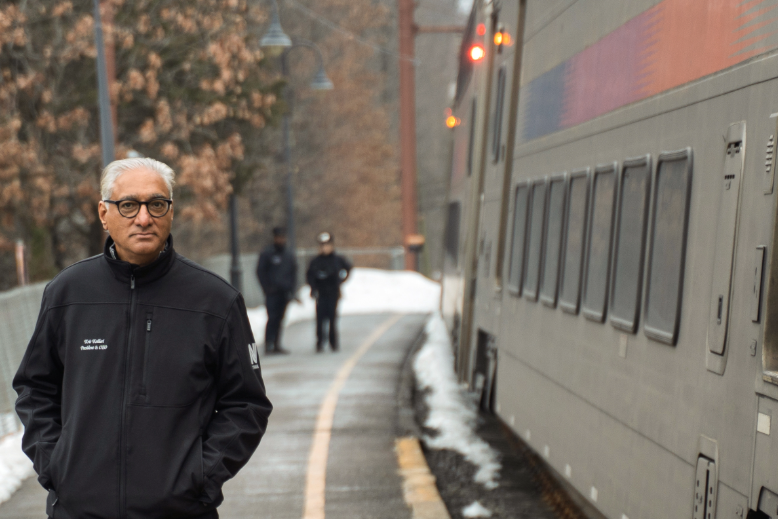
Ask any commuter about NJ Transit, and they’ll undoubtedly have a lot to say. So does Kris Kolluri, who serves as president and CEO of NJ Transit and executive director of the New Jersey Turnpike Authority.
This conversation has been edited and condensed for clarity.
What is NJ Transit doing to improve rider experience?
When Governor Sherrill came into office, her focus was on trying to get NJ Transit to be modern and reliable. It requires two parts: One is the foundational infrastructure, and the second part is the train cars and buses. On the first category, and you’ll see this in the budget, we are about to advance one of the most ambitious of infrastructure investments the state has ever seen. Equally important, the governor has committed to modernizing the buses and trains. Sixty percent of our buses, of our trains, are from the 1970s and ’80s. You don’t get to build a reliable system if you have train cars from that older generation. This year alone, we are going to start receiving 40 brand-new multilevel cars. We’re going to see about 180–250 brand-new buses that’ll get delivered just this year. And from that point on, we will essentially start receiving, between the two, several hundred a year, until 2031. So when you add these two factors together is how you build a reliable system.
What message do you have for commuters who will eventually enjoy the fruits of these labors, but who are experiencing issues right now?
I take the train every day, so it’s not like I don’t experience those dreaded middle seats. It would be a really nice day when we can say that those dreaded middle seats are being phased out, which is what we hope to do between now and 2031. I think the customers who long asked for reliability are finally in a position to see physical evidence of how that is going to happen. Let me talk about the Portal Bridge [over the Hackensack River]. This is a 116-year-old bridge, which every year would break down in the summer, and somebody would have to go there with a sledgehammer and knock the rails in place, because when the bridge opened they wouldn’t be able to close it. Sometimes it caught on fire. This was no way to run a modern rail system. So we, along with Amtrak, are replacing that bridge with a $2.3 billion brand-new bridge. The first track opened the 16th of March, and by the end of this year or early next year, the entire brand-new bridge will be open for traffic for the first time in 116 years.
How will this help with delays going into New York City?
The 10-mile corridor between Newark and New York Penn Station is the busiest train corridor in the Western Hemisphere. These bridges and, in some cases, the tracks themselves and the signal systems are decades old and, in some cases, [more than 100] years old. In the case of the Portal Bridge, it is 116 years old. So it is time that we replace them, and we’re working together to do that. The customers ultimately will be the beneficiaries of it.
How will the Gateway tunnel project make the commute into NYC easier?
The two new tracks that the Gateway tunnel will provide will allow Amtrak to repair the existing two tunnels one at a time. The existing tunnels are well over 100 years old and sustained damaged by Superstorm Sandy. The new tunnels will allow us to maintain full service while the existing tunnels are fully modernized. Once that rehab has taken place, it will set the stage for doubling the capacity—from 24 trains per hour during the weekday peak hours to 48 trains per hour—by having four tracks under the Hudson River in and out of New York City.
How does Governor Sherrill’s focus on affordability relate to NJ Transit?
When she ran for office, the governor talked about an affordability agenda that, in her view, is not only about trying to lower costs, but trying to make housing more accessible for people who can’t buy houses because the cost of housing is so expensive. At NJ Transit, we own about 8,000 acres of property. We are going to try and develop almost 800 acres of that property over the next 30 years. What does that look like? That means we can generate not only up to $60 million a year for NJ Transit, but we can also advance the governor’s affordability principles by building affordable and workforce housing on properties owned by NJ Transit next to bus stations and train stations. That $60 million a year roughly equals a 6 percent fare increase. I’m not saying we don’t need any other source of money, but I think in New Jersey, especially, we need to be, now more than ever, focused on how we can self-help. On financial challenges, families in New Jersey do it all the time. When they are in a bind, they don’t typically look to others to solve their problems. They tighten their belt, or they come up with ways to either save or to make more money. We are trying to do the same thing in New Jersey at NJ Transit.
This summer in New Jersey, it’s all about the World Cup at MetLife Stadium and going down the Shore. First, let’s talk about the World Cup. How is NJ Transit preparing to get fans to the games?
New Jersey has eight games coming up. We are responsible for moving 40,000 people per game. It is an extraordinarily complex, expensive proposition, but it is something that we should all be happy about and celebrate. But it is a challenge, a logistical challenge that we are trying to contend [with]. We’ve been planning for this for two years, and we look forward to moving 40,000 people.
How do you work to make things run smoothly with all those people and all those games?
We have to orchestrate a very complex set of operational rules, essentially focusing on moving fans four hours before the game and two hours after the game. But remember, our obligation isn’t just to the fans. Our primary obligation is to our commuters. We need to make sure that while we’re doing this game, we have to continue [to move] our commuters.
What lessons has NJ Transit learned, so far, in its World Cup preparations that you’ll use moving forward?
I saw firsthand the hard work and dedication of our NJ Transit employees delivering a seamless travel experience during last summer’s nine FIFA Club World Cup matches, including the finals. That was in addition to the dozens of major concerts and sporting events we successfully deliver every year to and from MetLife Stadium. We have been planning for the upcoming FIFA 2026 World Cup for more than two years, and each day I see how our employees are planning for success. Beyond the confines of World Cup, as I ride the train to work for my regular commute, I see this dedication each and every day, and that’s why I am confident we will have a great World Cup.
What’s your response to the controversy surrounding the $150 round-trip ticket price from Penn Station to the World Cup matches? How can you explain this price to people going to the games? [EDITOR’S NOTE: After this interview was conducted, fares were reduced to $105.]
In order to provide safe, reliable, and secure transportation to the eight matches at NYNJ Stadium [MetLife Stadium], NJ Transit needs to incur extraordinary security, labor, materials, and infrastructure costs totaling at least $48 million, or $6 million for each match. Governor Sherrill has been clear, and I agree, that this substantial cost should not be borne by our regular commuters. NJ Transit has committed to delivering a service that safely moves 40,000 fans per match to and from the stadium. The ticket price simply allows NJ Transit to just break even on the cost of providing that service over the course of the eight matches.
With Shore traffic a nightmare every summer, is there a focus on trains to the beach this season?
Taking the train down the Shore is a great idea to beat the traffic and parking. During the summer months, we offer additional train service between Long Branch and Bay Head, making it a convenient way to enjoy all that the Jersey Shore has to offer. And stay tuned for our promotional offers we provide during the summer for great savings.


Trending Story

