

Fish, crustaceans, insects and worms are among the staples of a seagull’s natural diet. Yet at the Jersey Shore, it seems they’re more attracted to pizza, french fries and funnel cake.
Take Ocean City, for example. Seagulls became increasingly aggressive as they swooped down from the sky, their beaks grabbing treats from people’s hands.
Mayor Jay Gillian’s patience finally reached its limit in 2019 when he witnessed a gull yanking a slice of pizza from a toddler in a stroller on the boardwalk. “I said, ‘That’s the last straw! Something must be done,’” the mayor recalls.
The city had already tried fishing line, jarring sounds and plastic owls to keep gulls at bay. Nothing worked. So Gillian assigned George Savastano, the city’s business administrator and municipal engineer, the daunting task of finding a humane solution to the escalating gull takeover.

Photo: Matt Zugale
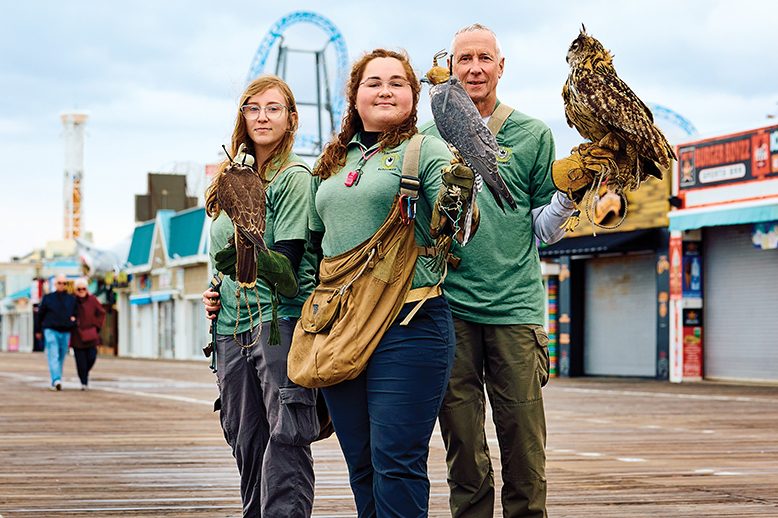
What Savastano came up with has been used successfully every summer since then: a professional team of falconers (bird handlers) who release trained falcons, Harris’s hawks and, occasionally, a Eurasian eagle owl into the Ocean City sky. It’s the only program of its kind at the Jersey Shore.
The goal is for these raptors, or birds of prey, to scare gulls back to bays, marshes and the ocean—their natural habitats.
“When George first told me about this idea,” Gillian recalls, “my reaction was, ‘You have got to be kidding!’ But the method has been very effective.”

Photo: Matt Zugale
According to Erik Swanson, owner of East Coast Falcons of Lodi, the Bergen County company that Ocean City hired for the gull abatement program, the problem isn’t that gulls prefer junk food to what they eat in nature. It’s that tracking down crabs and oysters requires effort, while grabbing a french fry from a person’s hand is a piece of cake.
Angelina Caselli of Newfield, Gloucester County, oversees the Ocean City falconers. Three of them traverse the boardwalk, beach and business districts every day, seven days a week, from 8 am-9:30 pm from Memorial Day to Labor Day, and on weekends for a month before and after the high season.

Photo: Matt Zugale
The 2026 price tag is $370,000, says Daniel Kelchner, the city’s director of community services. The cost is justified, Gillian notes, because “the problem had become more of a public-safety issue than a nuisance. The program helps not only our residents and visitors, but also the seagulls, whose health is improved when they eat what they’re meant to eat.”
Caselli, 22, was only 16 when she joined Ocean City’s seagull project, becoming manager three years later.
She says East Coast Falcons’ 16 birds have names. One falcon is named Karen “because she likes to talk a lot,” Caselli laughs. Two of Harris’s hawks are brothers Marco and Polo. Ozzy is the owl.
Caselli says the birds begin their training, which takes just a month, at the impressionable age of two months.

Photo: Matt Zugale
In Ocean City, about a dozen raptors take turns soaring for about two hours at a time before returning to their trainers’ arms, which are protected from their sharp talons by a falconry glove. What makes the birds return to the trainer? “They know they’ll get a treat,” Caselli replies. “They’re food motivated.”
Many beachgoers who frequent Ocean City’s sands are grateful for the program. “Three times I’ve had a gull take a slice of pizza from me,” says Vincent Malfitano, 63, an Ocean City novelist and retired attorney. “Now we eat inside a CoolCabana, which stops seagulls because they don’t come under things. The falcons and hawks help, plus they’re part of the entertainment.”


